
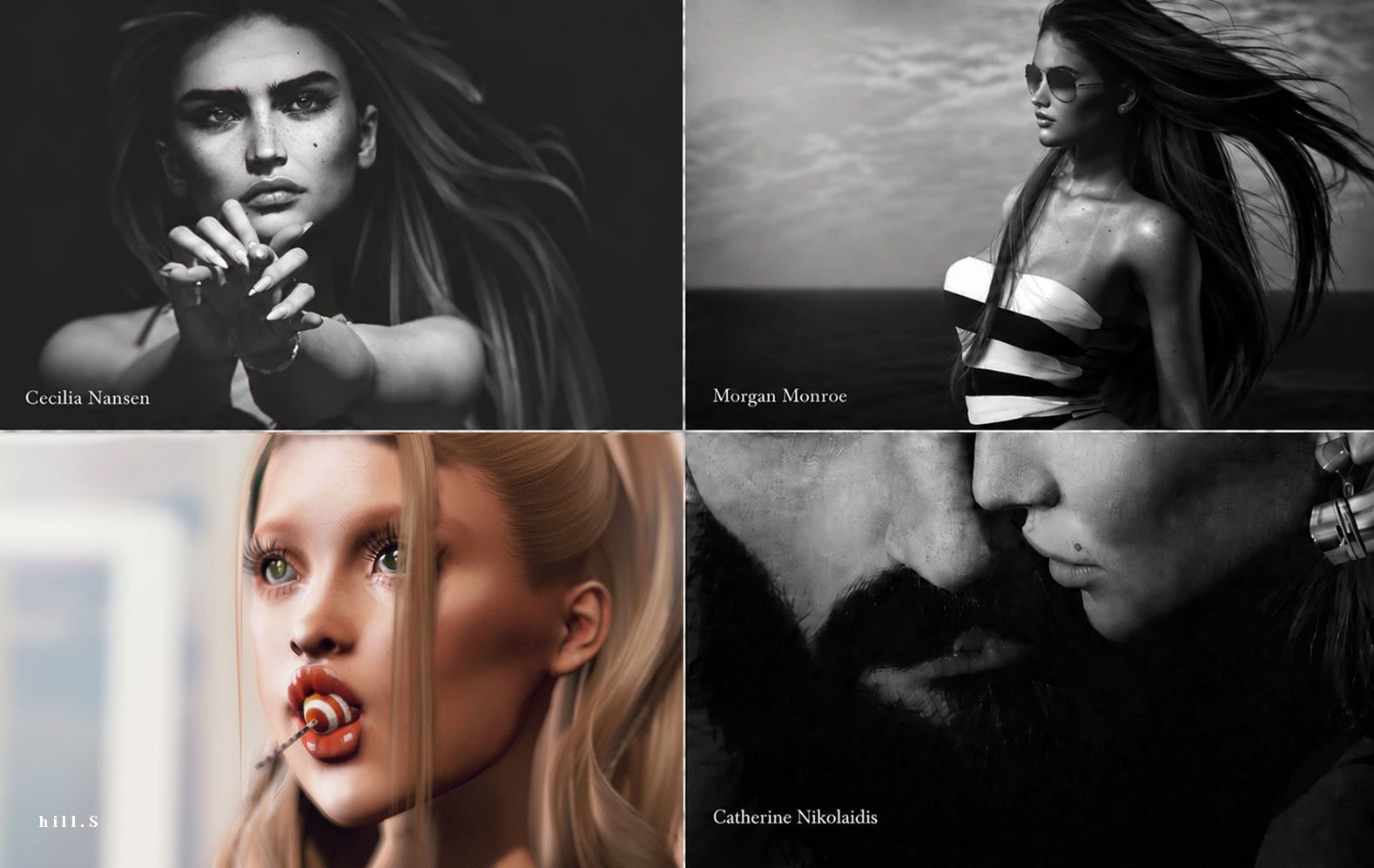

There is a fairly common misunderstanding when people talk about realistic avatars in Second Life: the idea that realism is only an aesthetic matter. A beautiful skin, a well-chosen mesh head, a proportionate body, a few facial details, a good lighting setup — and that’s it.
But it is not quite that simple.
Building a realistic avatar is certainly an aesthetic practice, but it can also become an artistic one. In fact, in Second Life the two often meet quite naturally. A believable avatar is not only useful for “looking good” in-world, taking part in the social life of the platform, or creating a more polished personal presence. It also becomes a visual instrument. A subject. Sometimes even a canvas.
And this is where Second Life reveals one of its most fascinating qualities: the possibility of turning a virtual identity into an image, an atmosphere, a story.
When the Avatar Stops Being Just a Character
A hyperrealistic avatar is not necessarily a “perfect” avatar. The point is not to create a cover-model face, obsessively symmetrical and polished like a skincare ad. True realism, at least the kind that works best in artistic imagery, often comes from the balance between proportion and imperfection.
A slightly heavier eyelid. A mouth that is not overly defined. Skin that does not look like plastic. Barely visible under-eye shadows, pores, freckles, subtle wrinkles, a nose with character. Small details, but decisive ones.
These are the elements that make an avatar usable in artistic photography. Because when a face is too generic, too “beautiful” in the most commercial sense of the word, the image risks becoming cold. Pleasant, perhaps. But silent.
A believable face, on the other hand, can withstand harsh light, a close-up, dramatic black and white. It can suggest a story without showing it. It can become melancholic, unsettling, vulnerable, theatrical, distant. It can communicate.
Black and White as a Test of Truth
Black-and-white photography is perhaps one of the areas where realistic avatars reveal their strength most clearly. Removing color means removing an important part of visual seduction. The warm tone of the skin is gone, as is the contrast between makeup and eyes, the palette chosen for the outfit or the background. What remains is the structure of the face, the light, the volume, the expression.
In Second Life, this is especially interesting because the image comes from a fully digital world, yet it can take on an almost photographic quality. Black and white tests the model, the texture, the pose, the direction of the gaze. If the avatar does not hold up, it shows immediately.
Here, realism is not simply “resemblance to reality.” It is visual credibility.
A good black-and-white portrait from Second Life does not necessarily have to make us forget that we are looking at an avatar. In fact, it can work precisely because it inhabits that ambiguous space between human and virtual. It is not traditional photography, but it uses its language: contrast, grain, shadow, depth, composition.
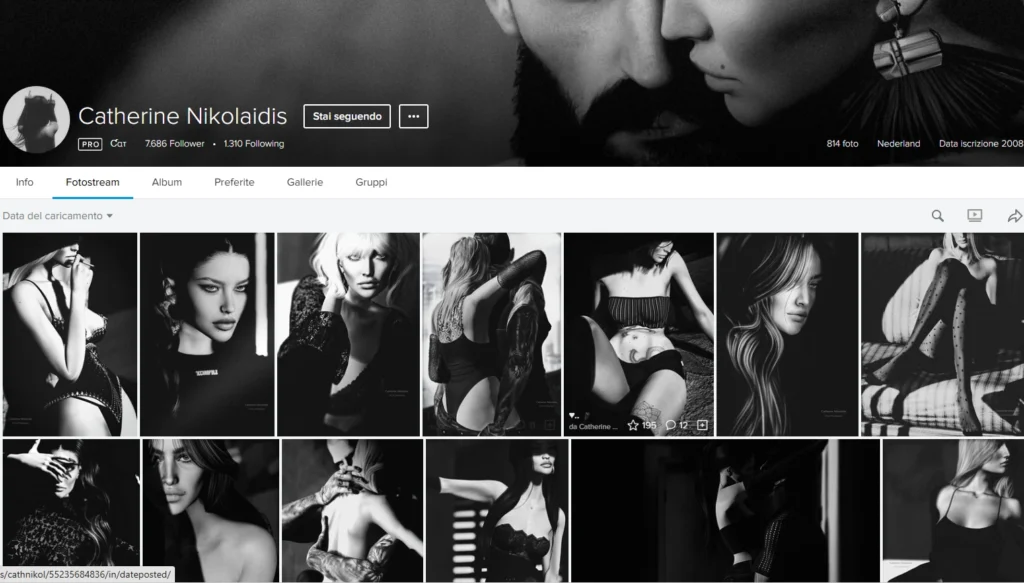
This approach can be found in the work of many contemporary SL photographers, where the avatar’s face is not treated as a simple screenshot, but as material for portraiture. I think, for example, of Catherine Nikolaidis, whose photographic work on Flickr clearly shows how a Second Life image can be built around presence, atmosphere, and control of the gaze. Her Flickr profile has been active since 2008 and includes hundreds of images, suggesting a long and recognizable visual research.
Geometries, Overlays, and Fragmented Identity
Another very strong direction in the art of realistic avatars is the use of geometric shapes, graphic cuts, overlays, and abstract compositions.
The avatar’s face can be crossed by lines, circles, rectangles, transparent surfaces. It can be duplicated, broken apart, reflected, almost dissected. In these cases, realism is not abandoned: it is put under tension.
And it is precisely this tension that makes the image interesting.
A realistic face placed inside a geometric composition creates an immediate contrast between body and construction, emotion and structure, identity and design. Geometry can become a cage, a frame, a lens. It can suggest control, distance, dissociation, awareness. It can transform the portrait into something more conceptual.
In Second Life, this visual language feels particularly natural, because everything is constructed: the body, the space, the light, the environment. A realistic avatar is no less artificial than a geometric form; it is simply an artifice closer to the way we recognize the human.
That is why it works so well when placed next to abstraction.
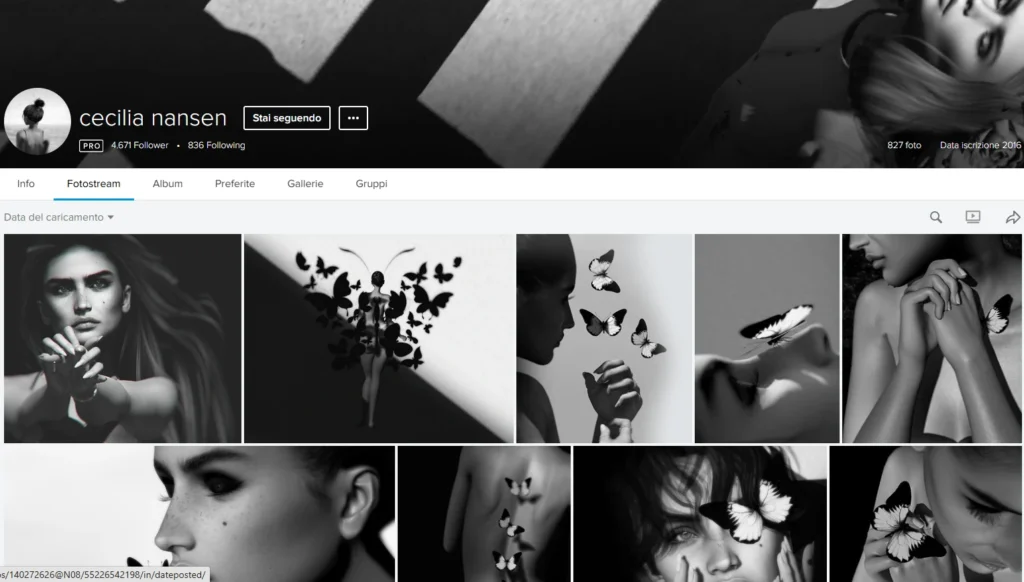
In this sense, artists such as Cecilia Nansen represent a very contemporary sensibility within SL photography: images where the avatar becomes part of a broader composition, often built around the balance between body, background, color, photographic framing, and atmosphere. Her Flickr profile includes hundreds of images and reflects a strong presence within Second Life’s visual community.
Light and Shadow: The Real Makeup of the Image
If there is one element that determines the quality of artistic photography in Second Life, it is light.
Light can make an avatar extraordinary or completely flat. It can sculpt the face, bring out the texture of the skin, add depth to the eyes, create mystery. Or it can destroy everything, turning even the best avatar into a weightless digital doll.
Anyone who works with realistic avatars knows this well: the skin alone is not enough. Nor is the most popular mesh head, the newest body, or the most refined makeup. Without coherent lighting, the image does not breathe.
Artistic photography in SL often uses sharp shadows, backlighting, side lighting, almost theatrical environments. You do not light everything: you choose what to reveal. And choosing what not to show is just as important.
A partially hidden face can be more intense than a perfectly visible one. An eye in shadow can say more than an explicit expression. A barely lit hand can become the emotional center of the image.
Realism, in this sense, is not an accumulation of details. It is control.
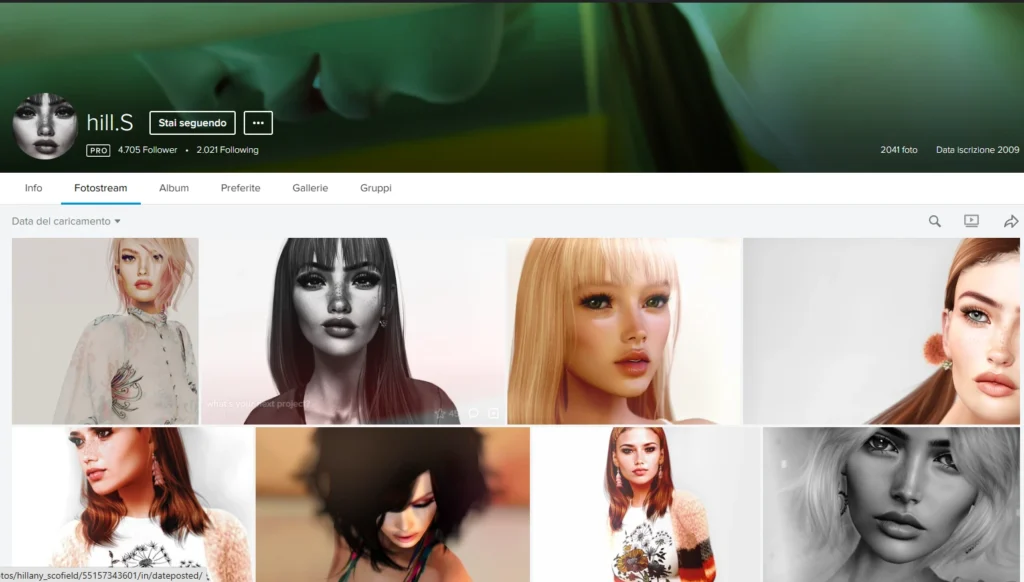
An interesting example, from this point of view, is hill.S, whose Flickr archive contains a very large body of SL imagery. Her work is worth observing precisely because it shows how pose, framing, environment, and styling can turn an avatar into a believable photographic presence, rather than simply a well-dressed digital model.
The Avatar as an Emotional Subject
When people talk about art in Second Life, they often think of large installations, immersive environments, and galleries built in-world. All of that is extremely important. But there is also a more intimate form of SL art: the portrait.
The avatar portrait can be fashion, of course. It can be blogging, styling, promotion. But it can also become something more personal. A way to represent states of mind, fragility, desire, solitude, identity, transformation.
This is where the realistic avatar becomes especially powerful. Because a well-built face can hold a minimal expression. It does not need to shout. It does not have to be surrounded by special effects. Sometimes all it takes is a gaze, a slightly closed pose, side lighting, an empty environment.
The strength of the image comes from restraint.
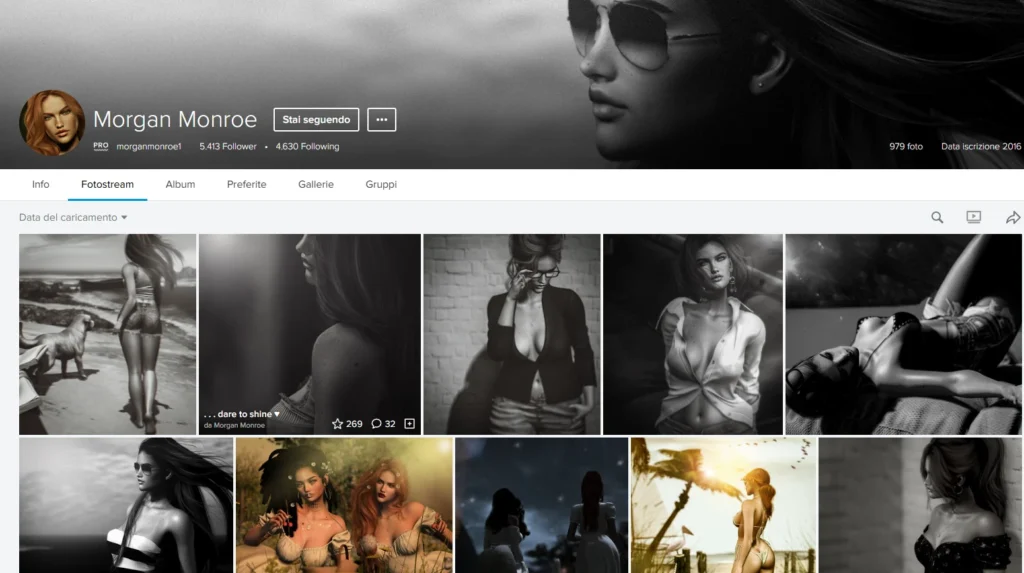
This is also where Morgan Monroe fits beautifully. Her photographic work on Flickr shows how the avatar can be treated as an editorial, emotional, and narrative figure. It is not only a matter of outfit or beauty: it is the way the image brings together styling, pose, scene, and atmosphere that determines the result.
From Realism to Vision
The most interesting thing is that hyperrealism in Second Life does not necessarily lead to simply “looking real.” In fact, often the opposite happens: the more believable the avatar is, the further it can be pushed toward the symbolic.
A realistic face can be placed inside a surreal landscape. It can appear in an empty room, in an abstract space, in an almost metaphysical composition. It can be duplicated, distorted, obscured, contaminated by color or black and white. It can become fashion, cinema, digital painting, psychological self-portrait.
The credibility of the body allows the image to take greater risks.
If the avatar is weak, if it lacks presence, if it looks too artificial in the wrong way, the whole composition loses strength. But when the face works, when the skin responds well to the light, when the pose is not stiff, then the image can afford to become more complex. It can move from portrait to vision.
This is where the art of realistic avatars becomes truly interesting: not in copying reality, but in using it as a starting point.
A Digital Art That Does Not Need to Apologize
Sometimes art produced in Second Life is still seen as something lesser: “just screenshots,” “just avatars,” “just a game.” That is a lazy reading.
Of course, not every image taken in Second Life is art. Just as not every photograph taken with a camera is artistic photography. The tool is never enough. What matters is the eye.
But when there is intention, composition, visual research, control of light, and a conscious use of body and space, Second Life becomes an incredibly powerful artistic environment. A place where photography, cinema, fashion, digital portraiture, and post-production constantly contaminate one another.
And this is precisely where the culture of the realistic avatar finds one of its strongest reasons to exist. It is not only about being beautiful in-world. It is not only about choosing the right head, the right skin, the right body. It is about the possibility of building a visual presence capable of carrying an image.
A realistic avatar can be elegant, sensual, melancholic, restless, vulnerable. It can be idealized or deeply human. It can become a mirror.
And perhaps this is exactly the point: the art of realistic avatars in Second Life is not only about the way we want to appear. It is about the way we can look at ourselves from the outside.
Not as real people simply transported into a virtual world, but as constructed identities, illuminated, staged, observed.
Identities that are not less true simply because they are digital.
Sometimes, in fact, precisely because they are digital, they are able to say something that would be harder to show in the physical world.
On Avatar Studio, we explore how realistic avatar customization, photography, styling, and visual storytelling shape the way we create identity in Second Life.
All images are original in-world snapshots created by Avatar Studio unless otherwise stated. Avatar Studio is an independent editorial site and is not affiliated with Linden Lab or the featured brands.
